
Leave types
Leave types help you track different kinds of time off in TimeOff.Management.
You can use them for holidays, sick leave, working from home, unpaid leave, overtime, TOIL, study leave, parental leave, or any other kind of leave your business needs.
A leave type is a category, not a budget. The allowance is the employee’s overall budget for the leave year. The leave type decides whether a request touches that budget at all, and on what terms.
To manage leave types, open Settings → Leave types.
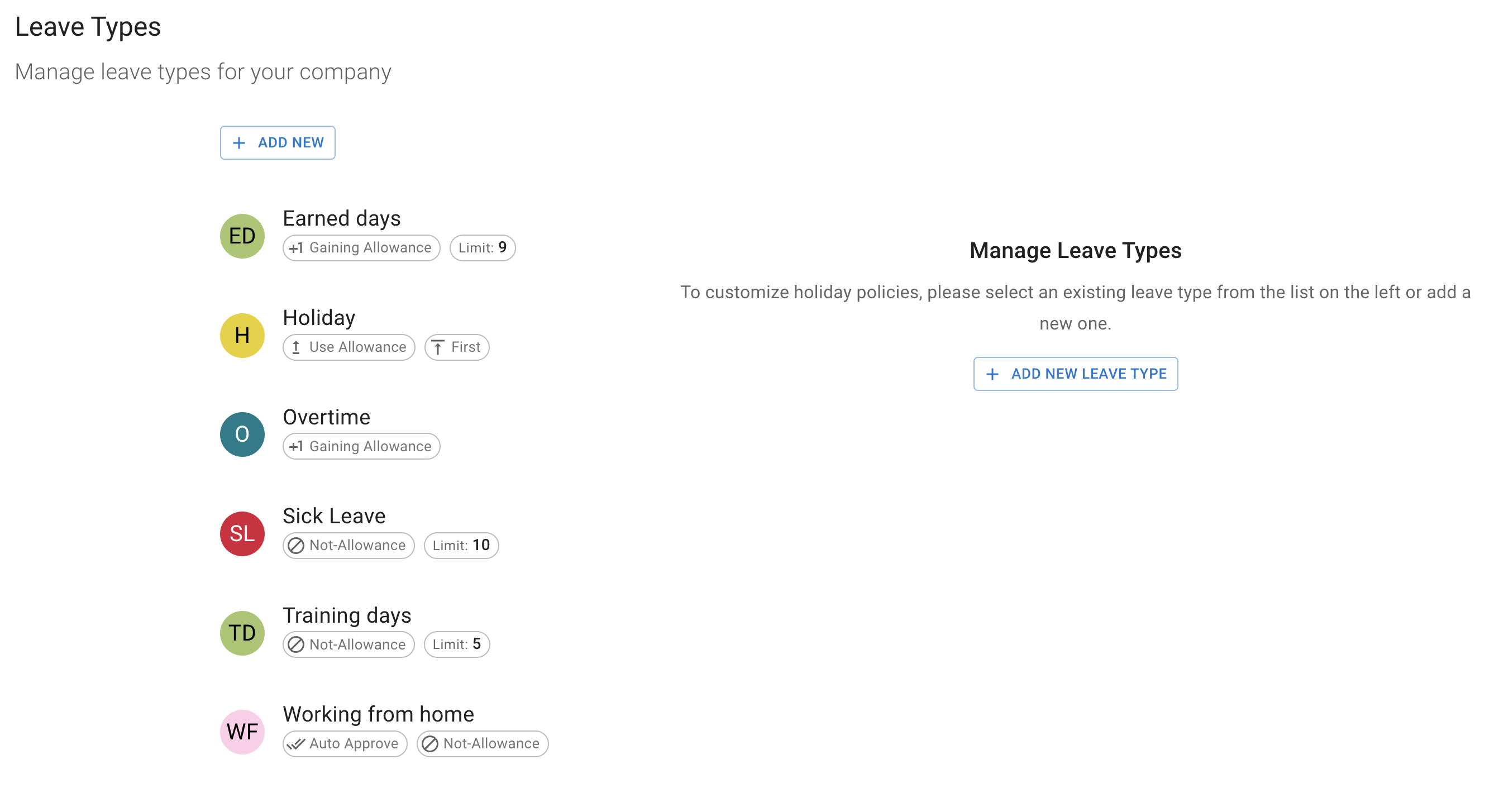
You’ll see every leave type your company has, each one summarised by a few tags: whether it Uses allowance, Adds allowance or Does not use allowance, any Limit, any Advance Notice, and which one is First. Archived leave types stay in the same list, struck through and tagged Archived. There is a search box for accounts with a long list, and Add new for creating one.
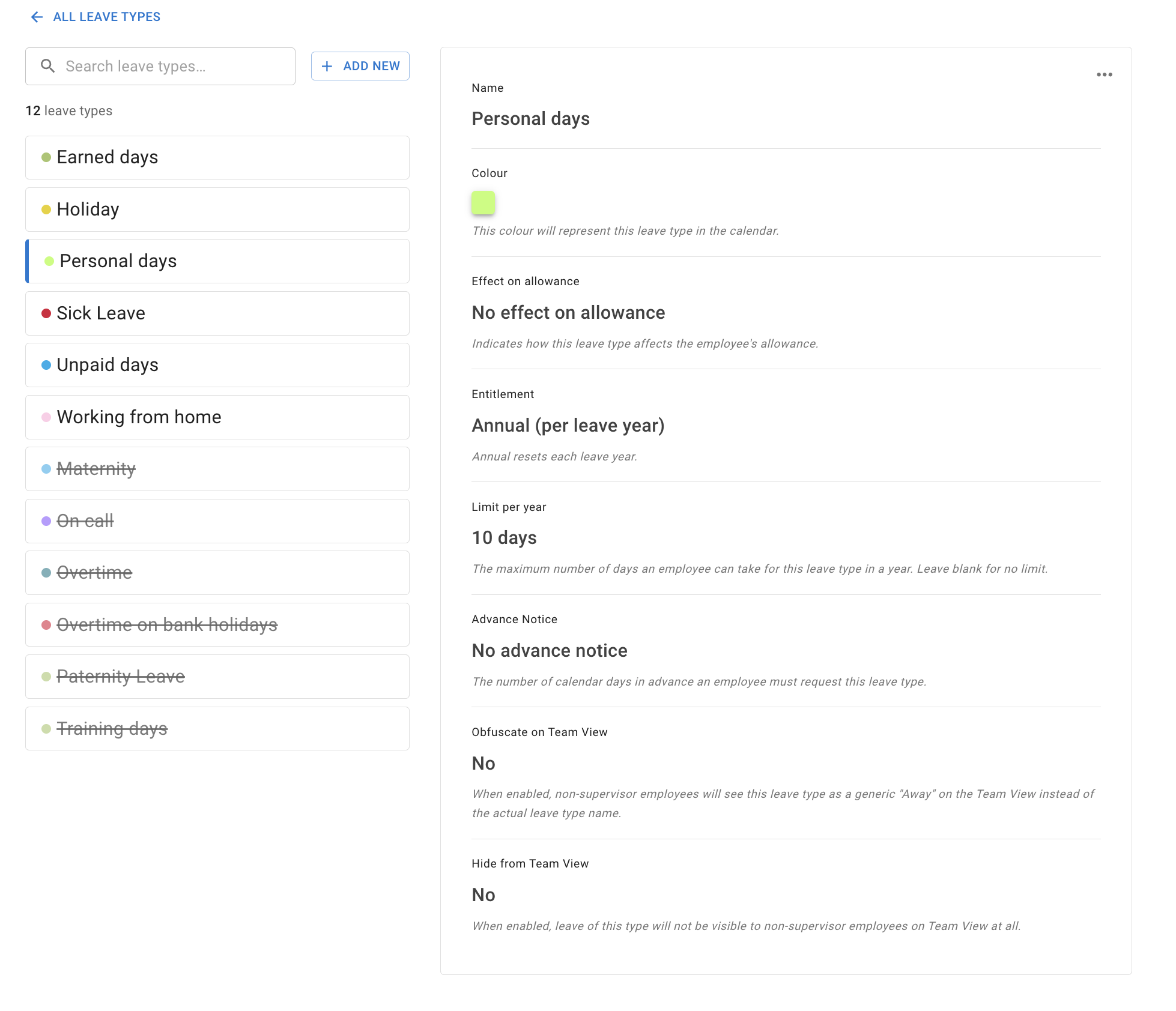
Selecting a leave type opens its details, where every setting below lives.
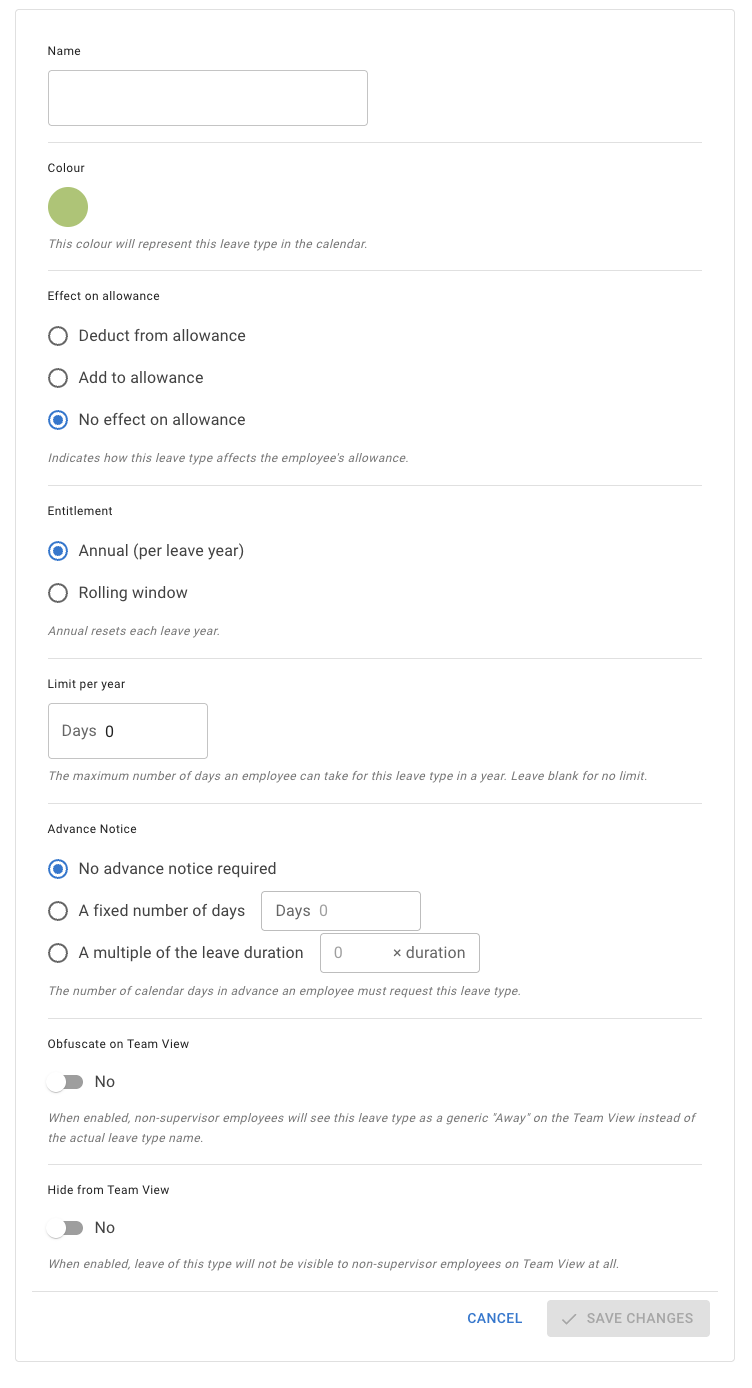
What you can set for each leave type
Each leave type can be customised to match the way your company manages time off.
You can set:
-
Name The name employees will see when booking leave.
-
Colour The colour shown on the calendar.
-
Effect on allowance This controls how the leave type affects employee allowance.
-
Deduct from allowance Use this for paid holiday or any leave that should reduce the employee’s balance.
-
Add to allowance Use this for leave types that add time back to the employee’s balance, such as overtime or TOIL.
-
No effect on allowance Use this when the leave should be tracked but should not change allowance, such as sick leave, working from home, compassionate leave or unpaid leave.
This is the setting to check first when something looks wrong. Sick days coming out of the holiday balance almost always means the sick leave type is set to deduct when it should have no effect.
-
-
Entitlement Choose whether usage of this leave type is totalled Annual (per leave year), resetting each leave year, or across a Rolling window measured back from the leave itself.
Annual is the default and the right answer for almost every company. A rolling window is a specialist option, for entitlements that are defined by a trailing period rather than by your company leave year.
Three things change when you choose Rolling window:
- The Effect on allowance choice no longer applies. A rolling leave type is governed by its own limit over the window rather than by the employee’s allowance, and the form says so rather than failing quietly.
- A limit becomes required rather than optional. The window only means something measured against a cap.
- Two further settings appear — Count bank holidays and Allow concurrent leave — which are not offered on annual leave types.
When an employee books a rolling leave type, they are shown where they stand against the limit for that window, so it is not a constraint they discover only when the request is refused.
Read more: Rolling window leave types
-
Coefficient Offered only when the leave type is set to Add to allowance. It scales how much allowance the employee gains relative to the time they record, so an hour of this leave type can be worth more, or less, than an hour of allowance. This is what makes overtime and time-in-lieu arrangements work without manual adjustments.
Read more: Allowance adjustment
-
Limit per year The maximum number of days an employee can take for this leave type. Leave it blank for no limit. It is often used for sick leave, unpaid leave, or other leave types that do not deduct from the main holiday allowance.
What the limit is measured over follows the Entitlement setting above. On Annual it is the leave year. On a Rolling window it is the number of consecutive months you set, so the rule reads as a number of days in any so many months — five days in any twelve consecutive months, for example — and the check looks back over that period rather than resetting on a fixed date.
Three things are worth knowing about limits:
- The limit is per employee, not per company. It is how much any one person may take, not a pool the team shares.
- It can be overridden for one employee — see Individual limits for leave types.
- Whether anyone may book past the limit is a separate, company-level decision — see Exceed leave type limits.
-
Advance Notice Choose whether this leave type needs notice, and how much: No advance notice required, A fixed number of days, or A multiple of the leave duration.
For example, a fixed 10 days for holiday means employees can only book that leave type at least 10 days before the start date. A multiple scales the requirement with the booking instead, so a long booking needs more warning than a short one.
Advance notice applies to employees booking for themselves. When an admin or a manager books on someone else’s behalf, it does not get in the way.
Read more: Advance notice for booking leave requests
-
Obfuscate on Team View Non-supervisor employees see this leave type on Team View as a generic Leave rather than by name. The leave still shows, so people can still plan cover.
-
Hide from Team View Leave of this type is not visible to non-supervisor employees on Team View at all.
These two are independent switches, and they apply to this leave type only. Admins and managers are unaffected by either and always see the real leave type. See Hide leave type details on Team View below for how they fit with the company-wide settings.
Approving a leave type automatically
Auto-approval is no longer a setting on the leave type itself. To have requests for a leave type approved the moment they are made, add an auto-approval policy and limit it to that leave type.
Two parts of the policy decide the rest. Scope says whose leave it covers — Apply to entire company covers everybody, or you can name employees, departments, locations or roles. Auto-approved actions says what completes instantly, and a new policy starts with all four switches on, covering revocations and on-behalf bookings as well as requests.
Where a two-tier approval policy also applies to a request, its screening step comes first unless the auto-approval policy is set to skip it.
Read more: Auto-approval policy
Control who can use each leave type
By default, every leave type is available to every employee. Creating one makes it available to the whole company, and most companies never need to change that.
Two things narrow it.
Leave Access policies
If different teams need different leave types, use Leave access in Employee policies.
A Leave Access policy groups selected leave types together and assigns them to:
- selected employees
- departments
- locations
This is useful when some leave types should only be available to certain people.
For example:
- Study leave may only apply to one department.
- A local leave type may only apply to one location.
- Senior managers may need leave options that other employees do not use.
Three behaviours are worth knowing before you adopt them.
Policies add up. An employee covered by more than one policy gets every leave type those policies grant, not just the ones from a single policy.
Once you use Leave Access policies, creating a leave type no longer reaches the people those policies cover. The leave types page becomes a library rather than a distribution list. A new leave type reaches an employee covered by a policy only after you add it to that policy as a second step. Employees who are not covered by any policy still follow the company-wide default and get it straight away — which is what makes a mixed set-up confusing. This is the single most common surprise for companies adopting the feature: if you have just created a leave type and the people who need it cannot see it, this is almost always why.
New departments and locations are not picked up automatically. Adding a department does not add it to any policy, so its employees will not receive that policy’s leave types until someone adds the department to it.
Read more: Employee policies - Leave access
The employee’s own Leave types tab
Every employee record has a Leave types tab, under Employee Details. It lists the leave types with an Is Available? switch and a Limit (in days) for each, so you can:
- switch one leave type off for that person, so it is not offered when they book; and
- give that person a limit that differs from the leave type’s own.
Use this for one-person exceptions, and a Leave Access policy for structural ones. Where a Leave Access policy governs an employee, the tab says so and shows only the leave types they have been granted.
If an employee ends up with no leave types available at all, the tab warns you — that employee cannot request leave.
Read more: Block selected leave types and Individual limits for leave types
Hide leave type details on Team View
Some leave types may be sensitive.
For example, you may not want everyone to see if a person is off sick, on unpaid leave, or using another private leave type.
Four separate controls decide what colleagues can see. They are in different places, so this section gathers all of them.
| Control | Where it lives | What it does |
|---|---|---|
| Obfuscate on Team View | The leave type | Non-supervisor employees see a generic Leave instead of the leave type name. The leave still appears, so cover can still be planned. |
| Hide from Team View | The leave type | Non-supervisor employees do not see leave of this type on Team View at all. |
| Hide Leave Type Details on Team View | General settings | The company-wide version. Applies to every leave type at once, and leave appears in grey rather than in the leave type colour. |
| Expose leave types in third-party calendars | Calendar feed settings | Whether leave synced out to Google Calendar, Outlook and similar names the leave type or shows a neutral Busy entry instead. |
Which to reach for:
- If only some leave types are sensitive, use the two settings on those leave types. They are the more precise instrument, and they leave everything else readable.
- If your company’s default posture is privacy, use the company-wide setting in General settings.
- Either way, check the calendar feed setting separately. It governs a surface your company does not control, so it is worth deciding on its own terms rather than assuming it follows the Team View choice.
Admins and supervisors are unaffected by the three Team View controls above and continue to see the full leave details their permissions allow. The calendar feed setting is a different kind of control — it decides what the feed itself carries, so do not assume the same exemption applies there.
Read more: Team View privacy modes, Team View leave data privacy options and Calendar feed company settings
Leave type actions
For each leave type, you can:
- edit the leave type
- archive the leave type
- move it to the top of the list
- delete the leave type, if no bookings exist
Archiving is the normal way to retire a leave type. Deleting exists for tidying up a leave type created by mistake, and the product will not let you delete one that has ever been used. If you want an obsolete leave type gone from the booking list, you want to archive it.
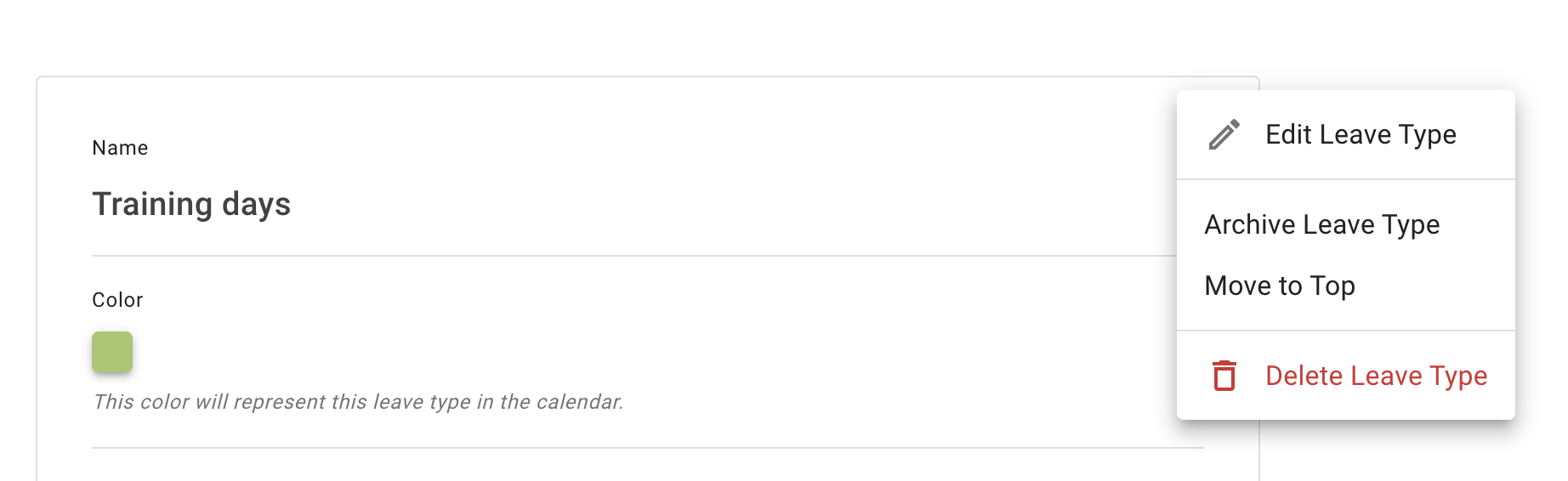
Edit a leave type
Select Edit leave type to update the leave type settings.
You can change the name, colour, allowance effect, limit, and advance notice.
After making changes, click Save changes.
Archive a leave type
Use Archive leave type when a leave type is no longer needed for new bookings.
Archived leave types cannot be selected by employees when they book leave. Old records stay in the system, so your reports and calendar history remain accurate. The product puts it plainly on the leave type itself: “This leave type is archived. It cannot be selected for new leave requests, and existing leave is unaffected.”
An archived leave type does not leave the Leave types page. It stays in the list, struck through and tagged Archived, so you can still see it was once in use.

You can restore an archived leave type later. Select it in the list, then use either the Restore leave type button on the notice or the same action in its menu. It moves back to the active list and can be used for new bookings again.
Move a leave type to the top
Use Move to top to change the order employees see when booking leave.
The leave type at the top does more than sit first in the list: it is the one the booking form starts on. Putting your most-used leave type there removes a step from the most common action in the product. The list marks which leave type currently holds that position with a First tag.
Put the most common leave types first. For example, many companies move Holiday to the top so employees can find it quickly.
Delete a leave type
Deleting is for a leave type created by mistake. For anything that has been in real use, archive it instead.
Use Delete leave type only when you are sure the leave type is no longer needed.
Deleting a leave type is permanent. It cannot be restored.
A leave type can only be deleted if no bookings exist for it. If any leave has ever been booked against it, the product refuses the deletion and points you at archiving, so that history, reports and balances stay intact.
Common problems
| What you are seeing | Why | What to do |
|---|---|---|
| Sick leave is coming out of the holiday allowance | The leave type’s Effect on allowance is set to deduct | Set it to No effect on allowance. See Why isn’t leave being deducted from the allowance? |
| A leave type will not delete | Leave has already been booked against it | Archive it instead |
| You created a leave type and the people who need it cannot see it | Those employees are covered by a Leave Access policy, and the new leave type has not been added to it | Add it to the relevant policy |
| One employee cannot book anything | Every leave type is switched off for them, or their Leave Access policy grants none | Check their Leave types tab under Employee Details |
| A new department is not getting the right leave types | New departments are not added to policies automatically | Add the department to the policy |
| Someone was blocked from booking and it is not obvious why | Usually advance notice, a leave type limit, or a clash with leave they already have where the leave type does not allow overlap | Check the leave type’s advance notice and limit first |
| Your team calendar is showing why people are away | The leave type’s visibility settings, the company-wide setting, or the calendar feed | See Hide leave type details on Team View |
Best practice
Keep your leave type list simple.
Start with the leave types most employees need, such as holiday and sick leave. Then use Employee policies if certain leave types should only be available to specific departments, locations, or employees.
This keeps booking simple for employees and gives managers better control over leave tracking.